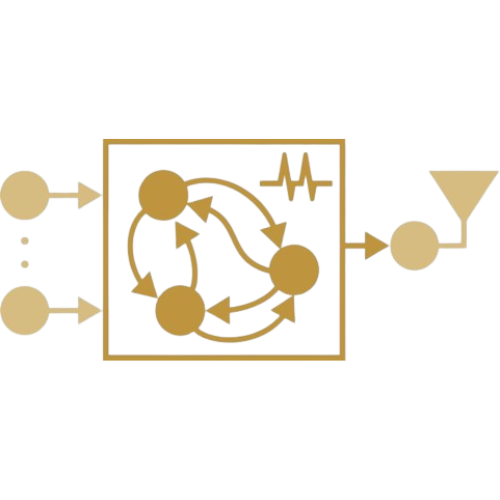
SWIMS proposes a bio-inspired paradigm shift for the design and hardware of future smart wireless multimodal sensory systems that use stochastic spikes for event detection and communication with exceptional energy efficiency. These technological advances are essential for deploying billions of future Internet of Things nodes to promote smart economy and society development with huge energy savings and low environmental impact. The synergistic interaction of four complementary skilled PIs enables the realization of a radically novel end-to-end stochastic analog spiking neuromorphic concept for SWIMS nodes, inspired by a small insect, that tackles sensor spiking signal generation, processing, and communication challenges with novel solutions at all levels.
SWIMS uses many innovative technological and system-level scientific advances to enable a neuromorphic architecture with
- new heterostructure spiking sensor arrays based on transition metal oxides/2D semiconductor, covering infrared, ultraviolet, acoustic, and electromagnetic detections, and
- hidden layers in tiny spiking neural networks based on novel CMOS Fe-FET concepts that can efficiently handle inherent stochasticity.
The synergistic connection will enable the initial design and experimental validation of event-driven demonstrators with optimized all-spiking multi-modal sensor nodes and 100x lower energy consumption than the current state of the art.
Motivational Background

The Internet-of-Things (IoT) is a pervasive technology whose widespread use will affect our society and economy. Only by saving energy and CO2 from the cloud to the IoT/Edge infrastructure can it operate sustainably. Energy restrictions on billions of IoT sensor nodes are crucial. To minimize environmental impact, sensory systems should use tens of μW of power gathered from the environment, rather than relying on billions of batteries. Current designs cannot continually operate and send high-resolution data due to energy overheads in sensors, block interfaces, data processing, storage, and wireless communication. SWIMS proposes energy-efficient architectures and technologies for smart multimodal sensory systems based on how honeybees use specialized neurons and time-modulated spikes to sense, process, and communicate at ultra-low energy.
This paradigm shift involves
- utilizing an end-to-end concurrent mathematical modeling and design approach that integrates computational principles inspired by insect brains,
- implementing analog time-based stochastic spiking sensing, processing, and communication functions that merge bio-inspired neuromorphic concepts with advanced materials and CMOS devices, and
- developing a transformative system designed for real-time, energy-efficient, task-based environmental monitoring. Breakthroughs that provide unique bio-inspired, smarter, and more energy-efficient features are essential for the convergence and sustainable deployment of IoT and Edge Artificial Intelligence (AI) sensory systems.
Research objectives / guiding questions
The future of electronics faces a significant challenge: is end-to-end stochastic analog spiking the most energy-efficient method for constructing remote multi-modal sensory systems for event detection in terms of sensing, processing, and communications? The objective is to determine the extent to which this innovative design approach can improve energy efficiency compared to current state-of-the-art methods.
The significant scientific and technological challenges of SWIMS are framed by the following guiding questions:
- How can we reinvent and optimize smart remote sensing systems using a unified system design architecture and mathematical engineering methodology?
- What functional advancements may new materials and device concepts bring to analog spiking sensory systems?
- What experimental setups and concise modeling are needed to characterize stochastic devices practically?
- How do we directly combine revolutionary energy-efficient analog spiking sensors with on-chip neuromorphic computation inspired by biological spiking neurons’ modest operation?
- How can wireless communication be introduced into the spike domain to interface to sensor data as efficiently as possible and transfer it using the least amount of energy?
- Can we design and optimize an end-to-end analog stochastic spiking distant sensing system for energy-efficient event identification?
Workpackages
WP 1 – System, theory, modelling, tradeoffs
Formulate mathematical models for spiking neurons, simulate neural networks inspired by insects, establish a framework for assessing energy consumption in wireless sensors, and design systems tailored for specific tasks or event detection.
WP 2 – Spiking sensors
Develop spiking sensors for ultraviolet, infrared, acoustic, and electromagnetic signals to facilitate energy-efficient, brain-inspired sensing across diverse environmental inputs for smart monitoring systems.
WP 3 – Analog stochastic spiking circuit architectures
Develop probabilistic techniques to evaluate, model, and design spiking components and advanced materials, resulting in a specialized spiking neuromorphic processor optimized for enhanced sensory system performance.
WP 4 – Task-based spiking communications
Develop ultra-low power spiking communication utilizing advanced coding, task-aware data transfer, RF components, and modeling of environmental effects while integrating communication with distance sensing to enhance the efficiency and adaptability of wireless sensor systems.
WP 5 – System design, benchmarking, life cycle analysis
Establish specifications and benchmarks; create the first-generation SWIMS sensory system; and enhance the second-generation SWIMS for improved energy efficiency and multi-modal performance.
WP 6 – Synergistic actions for deep scientific diving, dissemination, and exploitation
Conduct collaborative research and exchange programs; promote results through outreach; ensure industry awareness and acceptance throughout the long run.